 Add to Chrome
 Add to Firefox
 Add to Edge
Beyond Scalar Objectives: Expert-Feedback-Driven Autonomous Experimentation for Scientific Discovery at the Nanoscale
May 20, 2026
Self-driving laboratories or autonomous experimentation are emerging as transformative platforms for accelerating scientific discovery. Bayesian optimization (BO) is among the most widely used machine learning frameworks for these purposes, but these BO-based frameworks rely on predefined scalar descriptors to guide experimentation. In many situations, the determination of an appropriate scalar descriptor can be challenging, and may fail to capture subtle yet scientifically important phenomena apparent to experts with interdisciplinary insight. To overcome this limitation, here we develop deep-kernel pairwise learning (DKPL), an approach for autonomous microscopy experiments which incorporates human expertise and interdisciplinary scientific knowledge into an active learning loop. Instead of relying on explicit scalar objectives, DKPL enables experts to directly evaluate which experimental output is more promising using interdisciplinary knowledge. DKPL then learns a latent utility function from these expert judgements to guide subsequent autonomous microscopy experiments. We demonstrate DKPL's performance in learning physically meaningful nanoscale structures while effectively prioritizing high-information measurement regions using an experimental model dataset with known ground truth. We further apply DKPL to analyze the character of ferroelectric domain walls, where we find DKPL capable of distinguishing between high and low characteristic domain-wall angles in bismuth ferrite, and able to discover both head-to-head and tail-to-tail domain-wall character in erbium manganite. This development establishes an approach to integrate expert knowledge into autonomous microscopy experiments and demonstrates a pathway toward expert-guided self-driving laboratories capable of addressing scientific problems beyond the limits of scalar-metrics-driven learning.

Human-AI Collaborative Autonomous Experimentation With Proxy Modeling for Comparative Observation
Mar 13, 2026Optimization for different tasks like material characterization, synthesis, and functional properties for desired applications over multi-dimensional control parameters need a rapid strategic search through active learning such as Bayesian optimization (BO). However, such high-dimensional experimental physical descriptors are complex and noisy, from which realization of a low-dimensional mathematical scalar metrics or objective functions can be erroneous. Moreover, in traditional purely data-driven autonomous exploration, such objective functions often ignore the subtle variation and key features of the physical descriptors, thereby can fail to discover unknown phenomenon of the material systems. To address this, here we present a proxy-modelled Bayesian optimization (px-BO) via on-the-fly teaming between human and AI agents. Over the loop of BO, instead of defining a mathematical objective function directly from the experimental data, we introduce a voting system on the fly where the new experimental outcome will be compared with existing experiments, and the human agents will choose the preferred samples. These human-guided comparisons are then transformed into a proxy-based objective function via fitting Bradley-Terry (BT) model. Then, to minimize human interaction, this iteratively trained proxy model also acts as an AI agent for future surrogate human votes. Finally, these surrogate votes are periodically validated by human agents, and the corrections are then learned by the proxy model on-the-fly. We demonstrated the performance of the proposed px-BO framework into simulated and BEPS data generated from PTO sample. We find that our approach provided better control of the domain experts for an improved search over traditional data-driven exploration, thus, signifies the importance of human-AI teaming in an accelerated and meaningful material space exploration.
Physically-Constrained Autoencoder-Assisted Bayesian Optimization for Refinement of High-Dimensional Defect-Sensitive Single Crystalline Structure
Dec 29, 2025Physical properties and functionalities of materials are dictated by global crystal structures as well as local defects. To establish a structure-property relationship, not only the crystallographic symmetry but also quantitative knowledge about defects are required. Here we present a hybrid Machine Learning framework that integrates a physically-constrained variational-autoencoder (pcVAE) with different Bayesian Optimization (BO) methods to systematically accelerate and improve crystal structure refinement with resolution of defects. We chose the pyrochlore structured Ho2Ti2O7 as a model system and employed the GSAS2 package for benchmarking crystallographic parameters from Rietveld refinement. However, the function space of these material systems is highly nonlinear, which limits optimizers like traditional Rietveld refinement, into trapping at local minima. Also, these naive methods don't provide an extensive learning about the overall function space, which is essential for large space, large time consuming explorations to identify various potential regions of interest. Thus, we present the approach of exploring the high Dimensional structure parameters of defect sensitive systems via pretrained pcVAE assisted BO and Sparse Axis Aligned BO. The pcVAE projects high-Dimensional diffraction data consisting of thousands of independently measured diffraction orders into a lowD latent space while enforcing scaling invariance and physical relevance. Then via BO methods, we aim to minimize the L2 norm based chisq errors in the real and latent spaces separately between experimental and simulated diffraction patterns, thereby steering the refinement towards potential optimum crystal structure parameters. We investigated and compared the results among different pcVAE assisted BO, non pcVAE assisted BO, and Rietveld refinement.
A Fourier-Based Global Denoising Model for Smart Artifacts Removing of Microscopy Images
Nov 12, 2025Microscopy such as Scanning Tunneling Microscopy (STM), Atomic Force Microscopy (AFM) and Scanning Electron Microscopy (SEM) are essential tools in material imaging at micro- and nanoscale resolutions to extract physical knowledge and materials structure-property relationships. However, tuning microscopy controls (e.g. scanning speed, current setpoint, tip bias etc.) to obtain a high-quality of images is a non-trivial and time-consuming effort. On the other hand, with sub-standard images, the key features are not accurately discovered due to noise and artifacts, leading to erroneous analysis. Existing denoising models mostly build on generalizing the weak signals as noises while the strong signals are enhanced as key features, which is not always the case in microscopy images, thus can completely erase a significant amount of hidden physical information. To address these limitations, we propose a global denoising model (GDM) to smartly remove artifacts of microscopy images while preserving weaker but physically important features. The proposed model is developed based on 1) first designing a two-imaging input channel of non-pair and goal specific pre-processed images with user-defined trade-off information between two channels and 2) then integrating a loss function of pixel- and fast Fourier-transformed (FFT) based on training the U-net model. We compared the proposed GDM with the non-FFT denoising model over STM-generated images of Copper(Cu) and Silicon(Si) materials, AFM-generated Pantoea sp.YR343 bio-film images and SEM-generated plastic degradation images. We believe this proposed workflow can be extended to improve other microscopy image quality and will benefit the experimentalists with the proposed design flexibility to smartly tune via domain-experts preferences.
A Bi-channel Aided Stitching of Atomic Force Microscopy Images
Mar 11, 2025Microscopy is an essential tool in scientific research, enabling the visualization of structures at micro- and nanoscale resolutions. However, the field of microscopy often encounters limitations in field-of-view (FOV), restricting the amount of sample that can be imaged in a single capture. To overcome this limitation, image stitching techniques have been developed to seamlessly merge multiple overlapping images into a single, high-resolution composite. The images collected from microscope need to be optimally stitched before accurate physical information can be extracted from post analysis. However, the existing stitching tools either struggle to stitch images together when the microscopy images are feature sparse or cannot address all the transformations of images. To address these issues, we propose a bi-channel aided feature-based image stitching method and demonstrate its use on AFM generated biofilm images. The topographical channel image of AFM data captures the morphological details of the sample, and a stitched topographical image is desired for researchers. We utilize the amplitude channel of AFM data to maximize the matching features and to estimate the position of the original topographical images and show that the proposed bi-channel aided stitching method outperforms the traditional stitching approach. Furthermore, we found that the differentiation of the topographical images along the x-axis provides similar feature information to the amplitude channel image, which generalizes our approach when the amplitude images are not available. Here we demonstrated the application on AFM, but similar approaches could be employed of optical microscopy with brightfield and fluorescence channels. We believe this proposed workflow will benefit the experimentalist to avoid erroneous analysis and discovery due to incorrect stitching.
Towards accelerating physical discovery via non-interactive and interactive multi-fidelity Bayesian Optimization: Current challenges and future opportunities
Feb 20, 2024Both computational and experimental material discovery bring forth the challenge of exploring multidimensional and often non-differentiable parameter spaces, such as phase diagrams of Hamiltonians with multiple interactions, composition spaces of combinatorial libraries, processing spaces, and molecular embedding spaces. Often these systems are expensive or time-consuming to evaluate a single instance, and hence classical approaches based on exhaustive grid or random search are too data intensive. This resulted in strong interest towards active learning methods such as Bayesian optimization (BO) where the adaptive exploration occurs based on human learning (discovery) objective. However, classical BO is based on a predefined optimization target, and policies balancing exploration and exploitation are purely data driven. In practical settings, the domain expert can pose prior knowledge on the system in form of partially known physics laws and often varies exploration policies during the experiment. Here, we explore interactive workflows building on multi-fidelity BO (MFBO), starting with classical (data-driven) MFBO, then structured (physics-driven) sMFBO, and extending it to allow human in the loop interactive iMFBO workflows for adaptive and domain expert aligned exploration. These approaches are demonstrated over highly non-smooth multi-fidelity simulation data generated from an Ising model, considering spin-spin interaction as parameter space, lattice sizes as fidelity spaces, and the objective as maximizing heat capacity. Detailed analysis and comparison show the impact of physics knowledge injection and on-the-fly human decisions for improved exploration, current challenges, and potential opportunities for algorithm development with combining data, physics and real time human decisions.
Human-in-the-loop: The future of Machine Learning in Automated Electron Microscopy
Oct 08, 2023Machine learning methods are progressively gaining acceptance in the electron microscopy community for de-noising, semantic segmentation, and dimensionality reduction of data post-acquisition. The introduction of the APIs by major instrument manufacturers now allows the deployment of ML workflows in microscopes, not only for data analytics but also for real-time decision-making and feedback for microscope operation. However, the number of use cases for real-time ML remains remarkably small. Here, we discuss some considerations in designing ML-based active experiments and pose that the likely strategy for the next several years will be human-in-the-loop automated experiments (hAE). In this paradigm, the ML learning agent directly controls beam position and image and spectroscopy acquisition functions, and human operator monitors experiment progression in real- and feature space of the system and tunes the policies of the ML agent to steer the experiment towards specific objectives.
A dynamic Bayesian optimized active recommender system for curiosity-driven Human-in-the-loop automated experiments
Apr 05, 2023Optimization of experimental materials synthesis and characterization through active learning methods has been growing over the last decade, with examples ranging from measurements of diffraction on combinatorial alloys at synchrotrons, to searches through chemical space with automated synthesis robots for perovskites. In virtually all cases, the target property of interest for optimization is defined apriori with limited human feedback during operation. In contrast, here we present the development of a new type of human in the loop experimental workflow, via a Bayesian optimized active recommender system (BOARS), to shape targets on the fly, employing human feedback. We showcase examples of this framework applied to pre-acquired piezoresponse force spectroscopy of a ferroelectric thin film, and then implement this in real time on an atomic force microscope, where the optimization proceeds to find symmetric piezoresponse amplitude hysteresis loops. It is found that such features appear more affected by subsurface defects than the local domain structure. This work shows the utility of human-augmented machine learning approaches for curiosity-driven exploration of systems across experimental domains. The analysis reported here is summarized in Colab Notebook for the purpose of tutorial and application to other data: https://github.com/arpanbiswas52/varTBO
Combining Variational Autoencoders and Physical Bias for Improved Microscopy Data Analysis
Feb 08, 2023Electron and scanning probe microscopy produce vast amounts of data in the form of images or hyperspectral data, such as EELS or 4D STEM, that contain information on a wide range of structural, physical, and chemical properties of materials. To extract valuable insights from these data, it is crucial to identify physically separate regions in the data, such as phases, ferroic variants, and boundaries between them. In order to derive an easily interpretable feature analysis, combining with well-defined boundaries in a principled and unsupervised manner, here we present a physics augmented machine learning method which combines the capability of Variational Autoencoders to disentangle factors of variability within the data and the physics driven loss function that seeks to minimize the total length of the discontinuities in images corresponding to latent representations. Our method is applied to various materials, including NiO-LSMO, BiFeO3, and graphene. The results demonstrate the effectiveness of our approach in extracting meaningful information from large volumes of imaging data. The fully notebook containing implementation of the code and analysis workflow is available at https://github.com/arpanbiswas52/PaperNotebooks
Optimizing Training Trajectories in Variational Autoencoders via Latent Bayesian Optimization Approach
Jun 30, 2022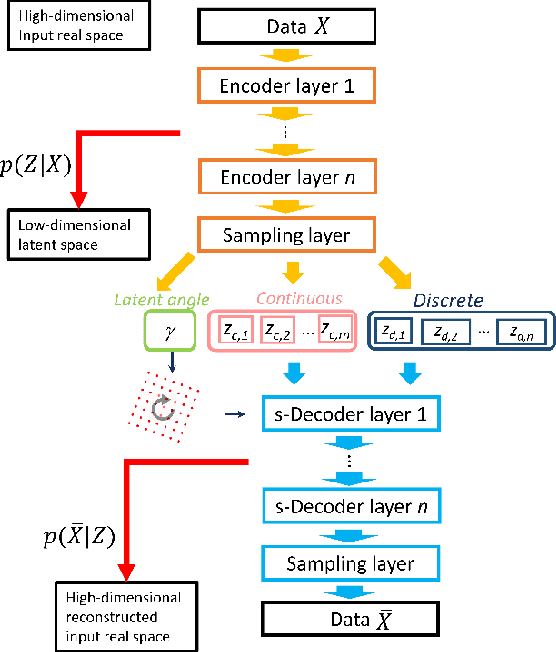
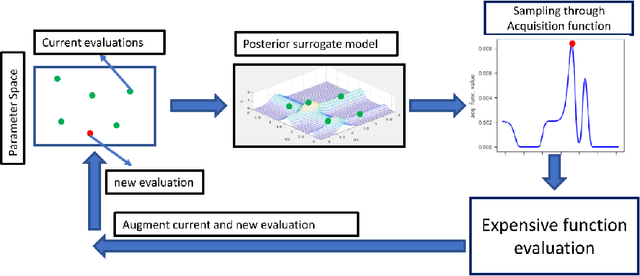
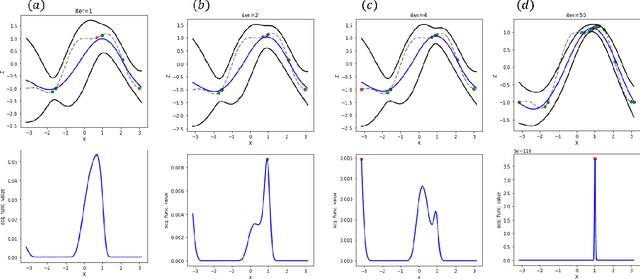
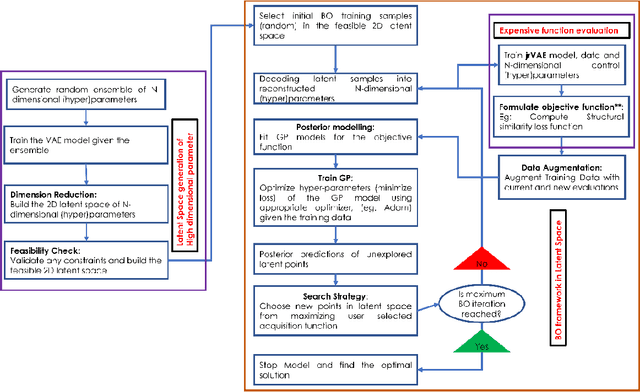
Unsupervised and semi-supervised ML methods such as variational autoencoders (VAE) have become widely adopted across multiple areas of physics, chemistry, and materials sciences due to their capability in disentangling representations and ability to find latent manifolds for classification and regression of complex experimental data. Like other ML problems, VAEs require hyperparameter tuning, e.g., balancing the Kullback Leibler (KL) and reconstruction terms. However, the training process and resulting manifold topology and connectivity depend not only on hyperparameters, but also their evolution during training. Because of the inefficiency of exhaustive search in a high-dimensional hyperparameter space for the expensive to train models, here we explored a latent Bayesian optimization (zBO) approach for the hyperparameter trajectory optimization for the unsupervised and semi-supervised ML and demonstrate for joint-VAE with rotational invariances. We demonstrate an application of this method for finding joint discrete and continuous rotationally invariant representations for MNIST and experimental data of a plasmonic nanoparticles material system. The performance of the proposed approach has been discussed extensively, where it allows for any high dimensional hyperparameter tuning or trajectory optimization of other ML models.